
Righting the Ship: Actionable Strategies for Project Recovery
Contracting on a Risk Adjusted Basis
The risk-to-return ratio in construction is among the most unbalanced of any mature industry. Which is to say that the disproportionate downside impacts associated with an extremely bad project far outweigh the upside gained from even the most successful outcomes.
At their worst, truly disastrous projects can cost contracting firms and owners millions of dollars, push their best people to the breaking point, and cause long-term damage to reputations and key relationships. At a minimum, these mishaps devastate project schedules, overrun budgets, alienate business partners and harm customer relationships.
Even the most promising design and construction projects can get quickly sidelined by a few missteps, a couple of bad decisions, misaligned expectations, or any other number of challenges.
In this article, we’ll explore some of the key issues that contractors, architects/engineers and owners encounter on their projects and describe common causes of these problems. We’ll also highlight the red flags that all project stakeholders should be aware of, and outline the steps that organizations can take to 1) avoid making the same mistakes repeatedly and 2) righting the ship on an existing bad project.
Drawing on DCS’ experience with project recovery, and an in-depth review of 35 “stressed” projects, this article highlights a broad range of project types that shared three common characteristics: They were behind schedule, they were over budget in various degrees, and they had multiple unresolved issues, many of which involved unresolved changes or claims.
Why Projects Take a Turn for the Worse
While the projects studied varied in type (general building, healthcare, water-works, highway/bridge, power), size ($30M – $1B), and delivery method (Traditional DBB, Design-Build, and CM/GC/CMAR), there were similar causal factors that led to the impacts on schedule and budget.
The question is, why were these projects behind schedule, and plagued by multiple unresolved issues. Below is a summary of key causal factors that were uncovered.
Time is of the Essence
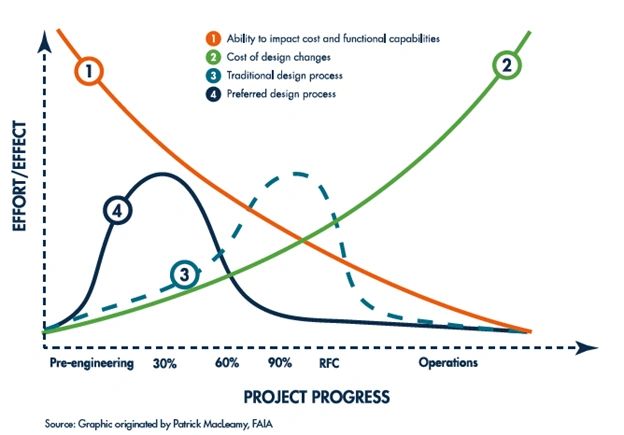
The impact of late design and late changes on the project dynamics is obvious. For example, curve 1 below shows that the “ability to impact cost and functional capabilities” is related to diminishing returns throughout the duration of the project. The trend toward tighter schedules and fast-track projects demands that the “traditional design process” (curve 3) move to the left and earlier in the design-construction cycle to the “preferred design process” (curve 4).
On the majority of the projects in the study, decision-making, approvals and other key processes would not support the schedule. As a result, the further the construction progressed, the higher the cost of the design changes (curve 2). All projects in this study with design-related issues were impacted by this key issue.
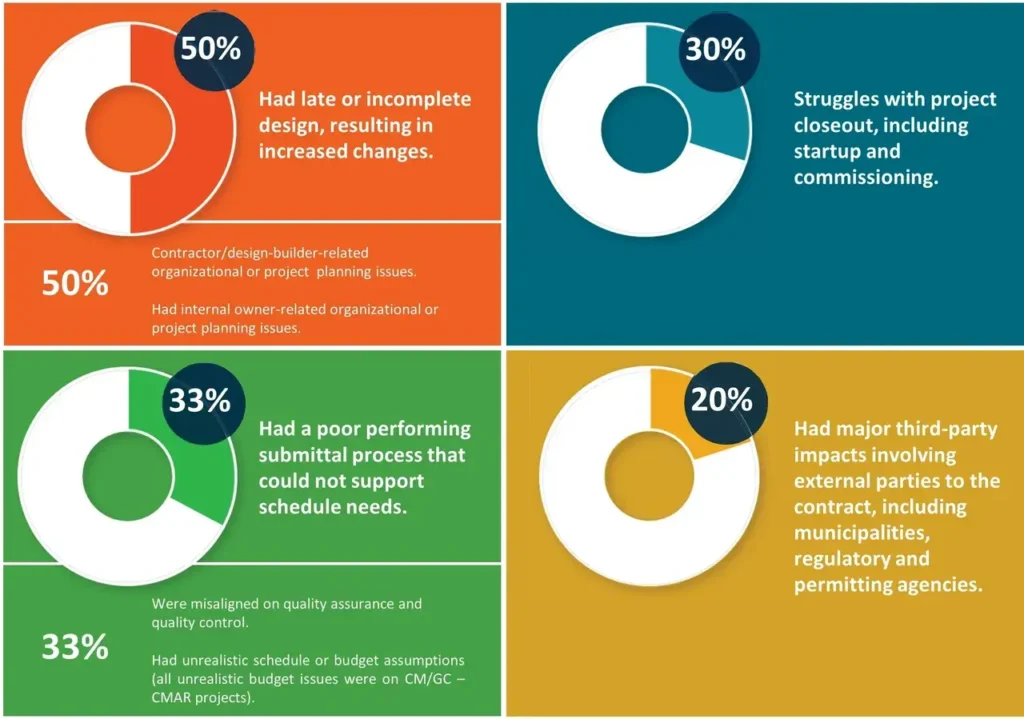
Half of the projects studied had late or incomplete design, a significant driver of the number of change orders. This is not necessarily a condemnation of architects or engineers, who are often limited by the allocated design budget and the owner’s decision-making process. However, it’s important to note that there is a natural upward pressure on budget and schedule on the following:
1) Traditional design-bid-build projects that are either dormant or recently brought back to life (usually with an obsolete or incomplete design that needs to be revised to meet field conditions).
2) CM-GC/CMAR projects where the scope of the project is misaligned with budget and schedule constraints.
In traditional design-bid-build, tension often occurs at the beginning of the construction phase, when the contractor enters the relationship and must match field conditions with the design. On CM-GC/CMAR projects, the tension is moved up in the cycle to the pre- construction phase, where owners, designers and contractors grapple with questions around scope reduction while trying to meet the project objectives and stay on budget. Now it’s important to note that team dynamics will spiral downward quickly when there isn’t a high level of trust among the owner, designer and contractor regarding the budget.
Integrated Project Delivery (IPD) attempts to address this contractually, but regardless of the methodology, innovative leaders must think outside the box to keep their teams working collaboratively and avoid increased costs and mistrust.
On certain types of projects (such as health care and technology), budgets tend to rise “naturally.” These and similar projects are driven by end-user demands for the latest and greatest equipment or technology right up until project completion. Executives must take measures sooner than later to contain these demands on traditional design-bid-build or CM- GC/CMAR projects, including:
1) Owners recognizing that they must lead the decision-making process and, as such must streamline that process without relinquishing responsibility for control of the design to the contractor (or assume that the contractor and designer will naturally collaborate), unless the contract is structured in such a manner.
2) Setting expectations with and including end-users early in the process and throughout the duration of the project. This requires a seasoned owner team that has the ability to say “no” to end users and not capitulate to demands (unless there is corresponding funding to support the changes).
3) Differentiating between what the facility must have and what is merely a want or desire.
4) Drawing a line in the sand on when all changes must end to support the schedule objective.
In a League of Its Own: Design-Build
When it comes to project stress, design-build presents its own set of challenges that revolve around:
- The differing roles assumed by the parties.
- The number of decisions that must be made simultaneously.
- The increased speed of decision-making associated with compression of the design and construction cycle.
With design-build, owners’ use of a new alternative delivery system purely for procurement purposes—and without aligning the decision-making/approval processes within the organization to meet the schedule needs—can set up a project for failure. People within the organization may resist this fundamental shift and proceed the same way they have always operated. Or contractors may get sucked into the notion that alternative project delivery will be the Holy Grail of collaboration without thoroughly understanding the owner or organization that they are working with.
Misaligned expectations between the owner and design-builder regarding the level of control that the owner’s team retains over design decisions can also derail a project. In our study, design-builders generally went into the design phase assuming they would have more influence over design decisions than they ultimately would. This was particularly prevalent with structural issues where calculations, recalculations and constructability approaches were frequently debated.
Other design issues on stressed design-build projects include:
- Design-builders not designing to specific requirements or to other owner specifications, or performing inadequate quality control on packages, which can lead to an abundance of comments and ultimately the rejection of the package(s).
- Not putting an appropriate feedback and comment resolution process in place. Too many inappropriate comments at early design stages can add time to the design-build process because designers will be forced to deal with these queries and close them out before documents can be approved for construction.
- Unclear roles for reviewers in the design-build process and the basing of those reviews on preferences versus reviewing to spec. This can negatively impact schedule and budget because design-builders don’t typically factor preferences into their budgets or schedule plans.
- Availability of decision-makers from the owner team and third parties (with review responsibilities) at task force meetings/technical work groups or other appropriate forums. The speed of decision-making requires reviewers to set aside the appropriate review time within set time frames. Late comments only cause schedule delays as the contractor is then forced to take a step back from the planned design and construction path.
- The ability to co-locate the owner and design representatives. Over-the-shoulder reviews between these representatives are paramount to keeping the design on schedule where the designers are still allocated appropriate time to complete their work. On-site representation of designers for critical periods of time during design or construction will positively impact the schedule.
Managing Changes
In construction, most disputes involve the fair and equitable resolution of financial issues. As such, the project team’s ability to swiftly resolve disputes is one of the leading indicators of project success (or failure). The source of changes can come from any number of factors. For example, curve 2 above graphic shows how an increasing number of changes and associated costs lead to design delays.
Over 40% of the projects in our study had spiraling budget costs due to changes. On some of these projects, up to 20% of the base contract dollar amount was tied up in unpaid changes or unresolved financial disputes. This directly impacts the cash flow of the contractor/design-builder. These issues exacerbate when a contractor is managing a contract that includes liquidated damages and that compels the company to move the work forward. Once there is written acknowledgement that a change exists, the contractor proceeds and the price of the change can be negotiated at a later date. The longer “open” changes go unresolved, the greater the probability of a dispute and increased tension among the project team, which can severely hamper collaboration.
To deal with the unresolved backlog of changes that has developed, the parties can take the following steps:
- If the owner’s or contractor’s project-level manager is not authorized to approve changes above a certain dollar threshold, the team should establish a disciplined escalation process. The escalation “ladder” should include strict time limits on how long a change will stay with the staff-level change order team before it gets escalated to senior management. This should keep the flow of issues moving and help prevent negotiations from stalling.
- Once the key issues/disputes have been escalated to off-site senior management, establish a regimented and disciplined change process and then keep the flow moving by following that process throughout the duration of the project. That way, the parties won’t default to “scramble mode” when the backlog of changes and costs keeps increasing to an unacceptable cash flow position for the contractor.
- Both parties should staff the project with seasoned change personnel to organize, estimate and negotiate the changes. Then the project staff can focus on pushing the work in the field to project completion (i.e., schedule and resources). Too often the project managers are too busy to negotiate all of the changes and effectively drive the project to completion.
Contractors should always maintain focus on the development of big-picture solution(s) that will help meet the owner’s objectives (e.g., facility functionality, safety, saving time and money). Put simply, do not submit only cost-added changes and, instead, focus on developing cost savings and value-added changes.
What Can Go Wrong, Will Go Wrong
When problems start to spiral out of control and project timelines and goals get derailed, it doesn’t usually take long for the finger-pointing to start. After all, finding the culprit, calling him or her out, and then finding ways to place the blame are just human nature.
But this approach really doesn’t have a place in the engineering and construction sector, where owners, contractors, designers and other entities all bear the responsibility for projects that get into trouble. Sure, some factors are jointly shared and others are unique to specific project stakeholders, but in the end, all parties contribute to the success or failure of any given project. However, owners ultimately must lead and establish an environment for success on how business will be conducted.
So while a proactive contractor can certainly help to rectify the issue, it is nearly always the owner who must be the guiding light in these situations. With this in mind, the selection and deployment of a project management team is a major contributor to project success or failure. Here’s how the responsibility breaks down:
Project management team experience
.png/:/cr=t:0%25,l:0%25,w:100%25,h:100%25/rs=w:1280)
Owner Items
In the study, 50% of the projects contained elements of at least one of the following internal owner factors impacting the project:
- Inexperience with the use of a new project delivery system
- Inexperienced project staff
- Poor decision-making and issue resolution processes
- Unbalanced application of the contract requirements versus collaborative problem resolution by the CM for fee/program manager
Contractor/Design-Builder Items
Of the projects studied, 50% contained elements of at least one of the following internal to the contractor/design-builder:
- Misread of requirements/poor bidding assumptions (particularly on design- build projects)
- Inexperience with the type of work
- Inexperienced project management
- Unaligned internal joint venture team
- The perfect storm is created when an inexperienced owner organization with poor decision- making is matched with an inexperienced contractor who is not fully organized or staffed at project initiation.
This often leads to each party defaulting to its interpretation of the contract to resolve every inevitable issue that arises on the project. Executives only intervene in a “reactive” manner, when things have reached a crisis mode and changes/financial outlays have reached an unsustainable level.
Setting the Stage for Success:
Owner Considerations
- Choose alternative delivery systems only when the organization is aligned internally on the speed of decision-making that will be required to support the project schedule.
- Be as clear as possible during the procurement phase on requirements, priorities, uncertainties and the likelihood of changes and betterments.
- Establish a prompt decision-making path with a point person who is empowered and/or available to escalate issues. Determine how to get decision- makers available for critical pieces of the design to keep it on track.
- On larger projects with bigger risks, make available a senior-level individual with corresponding approval authority for the increased dollar value of the issues at hand. Don’t wait for decisions to flow up in the normal mode.
- Make clear what decision-making authority the CM for fee/program manager will have with a well-defined handoff to an owner representative for decisions.
- Ensure that the CM for fee/program manager understands its role to help resolve problems for the good of the project, and on behalf of all parties, versus simply applying a strict interpretation of potentially “gray area” requirements.
- Do not abdicate all decision-making to the CM for fee/program manager and have an owner representative available on a daily/weekly basis to make appropriate decisions.
- Write contracts that align contractor objectives with A/E objectives so that all parties are working toward a common goal. Ensure contract language is results- oriented versus prescriptive in regard to methods, materials, technical concepts, etc.
- Be ready to make a deal and do not defer issues to the end of the project.
Contractor Considerations
Pursue projects that are within the organization’s range of experience or hire an individual with the experience in that type of work and make sure he or she is a good cultural fit.
- Assess the owner’s motivations for project delivery system choice and include them in an overall risk assessment. A key question becomes: Has the owner just compressed the schedule but with the same decision-making processes?
- Develop a comprehensive risk register that identifies both insurable and uninsurable risks and mitigate strategies for each. The thought exercise a project team goes through in developing a risk register is just as important as the output.
- On larger, more complex projects, commit an executive-level resource at the outset until strategies for project risk mitigation have been developed and implemented. Avoid assigning a junior project manager who may take on more than he or she can handle and who may fail to report issues upstream (intentionally or not).
- Make sure you completely understand requirements or other bidding assumptions, particularly on design-build projects. Of the projects studied, 25% fell victim to this. At times, even the owner will not understand the true impact of some of the requirements written into the contract.
- Ensure proper staffing at the beginning of the project and at critical project phases (or in critical project disciplines). Again, of the project studied, 25% fell victim to this. In particular, staffing for change orders must be closely monitored so that the contractor keeps pace with responding to and pricing changes. Playing catch-up on the backend of a project—when resources should be focused on commissioning and project turnover—will place additional stress on all team members.
- Choose your joint venture partners wisely and work diligently to create internal alignment within the team on all critical processes. Ensure organizational cross-fertilization across the disciplines to avoid silos of work responsibility or chasms between the field and office staff.
- Make sure there are formal internal hand-off meeting(s) between estimating/ preconstruction and project management/field operations. This should include subcontractor involvement in planning the work.
A/E Considerations
Although A/Es take their cues directly from the owner or from the contractor (in design-build), they are not exempt from their fair share of the responsibility in causal factors on stressed projects—or their responsiveness and willingness to work with all parties to turn things around. A/Es can proactively:
- Fully understand the owner’s intentions. Work with the owner to establish an adequate budget for the actual design and construction administration phases to do the job properly. Negotiate hard to ensure that owner changes, betterments, on-site presence and adequate resources are provided for timely and efficient review of contractor RFIs and submittals.
- Set clear expectations regarding the level of design that can be produced for the budget provided.
- Be mindful of the schedule and design production’s impact on it.
- Work with the team to establish clear expectations for RFIs and submittals and develop noncontractual targets for information turnaround that will support the schedule, particularly on critical items.
- Be open to contractor-generated ideas that will preserve/enhance quality and create financial savings (e.g., materials or constructability).
- Engage and work with the contractor to improve the design per constructability input and avoid an overly defensive posture on the documents.
- Develop big-picture solutions with the contractor to achieve the owner’s objectives.
How Key Processes Can Trip Up Project Success
According to our study, 33% of projects had a poor performing submittal process that would not meet the schedule needs. This proves the critical importance of a good, viable submittal process to a project’s overall success. All involved parties are responsible for a piece of this process, as the problems directly revolve around how well the parties are communicating before a submittal enters the system. This includes timeliness and the level of submittal completeness, types of comments, definitions of what will be returned as “approved as noted,” “revised and resubmitted,” and so forth.
A critical metric to monitor in this process is the number of cycles (back and forth) it takes to gain approval and the percentage of approvals within each cycle. The objective is to alter communication processes so the “ping-pong” effect is reduced, approval percentages are improved by cycle, and approvals are gained in fewer cycle times. Meeting schedule needs should trump contractual commitments on review times.
If every submittal/RFI takes up the maximum review time (as defined by the contract), then all parties know the team will never meet the schedule. On stressed projects, first-cycle approvals are only at 25-50% and sometimes require as many as five cycles to gain approval. Given that contractors typically only have one review cycle in their bids, there is an immediate impact on the schedule and budget. A best-in-class project had an 85% approval rate on the first cycle. To achieve this level of project success, contractors and owners/ agencies should focus on the following:
- Develop a reliable submittal schedule that the owner/reviewers can use to align resources with the schedule.
- Confirm submittal requirements by actively pushing for pre-submittal meetings/ conference calls with reviewers.
- Know the organization’s review cycles and third party’s review cycles and build those into the initial schedule that goes into the RFP. Assume multiple cycles will be needed.
- Invest to ensure reviewers are co-located/available to answer the inevitable questions that will arise during the submittals and during the construction phase to keep the project moving. Contractors can also do this on design-build projects.
Project Closeout
Project closeout is another area where even the best-laid plans begin to unravel. In fact, 30% of the projects studied struggled with project closeout, including start-up, commissioning, O&M and training. Some of this can be attributed to contractors who don’t fully understand what will be required to gain substantial completion when bidding the project. This struggle point may also involve projects that fall behind schedule early. In these situations, while trying to catch up, the team neglects closeout processes and responsibilities until it may be too late in the game. Only then does the team face the reality of what it will really take to get to the finish line. This new information frequently pushes the schedule out further.
The good news is that the sooner a cross-organizational team begins planning closeout, the better the outcome. An active commissioning and closeout team (sometimes called a “red- zone” team) should be established no later than when the project is 50% complete. This team should report to senior management on progress achieved and open issues.
Defining the acceptance process among all stakeholders and defining substantial completion early will help determine how the schedule will unfold. On design-build projects, this should begin in the design phase and be incorporated into the schedule. Contractors should plan to have a commissioning agent and other related personnel staffed early enough to get ahead of the game on O&M requirements, training plans and schedule training sessions.
Quality Assurance and Control
The QA/QC process correlates directly to project acceptance. In fact, it was found that QA/QC problems existed on 30% of the stressed projects studied. For example, QA/QC issues on the traditional design-bid-build projects typically revolved around misalignment within the owner team between agency quality representatives and the CM for fee/program manager staff and third-party inspection team representatives.
This resulted in diverging opinions and direction to the contractor on what is acceptable, causing inevitable delays in closing out work.
On design-build, issues arise around the different roles assumed regarding oversight versus QC. On all projects where contractors/design-builders have a QC component of their contract, the most frequent complaints from owners were:
- Contractors’ QC processes are not catching quality issues and are relying on the owner team to do it for them.
- Deficiencies, nonconformance and other issues are not addressed timely.
- Contractors’ paperwork responsibilities fall behind and are not timely.
When these issues are addressed early in the construction phase, it’s easier to keep peace out in the field. Left unresolved, the tension will continue to build; when work is rejected, the schedule will be further delayed and cause even more stress for all participants.
Five Ways to Right the Ship
Previously, we outlined some of the main causal factors associated with stressed projects. For projects that have experienced one or more of those causal factors, there may be interest in bringing on neutral outside assistance to help with the turnaround efforts. The causes of stressed projects are numerous and varied, and as such, there is no one-size-fits-all approach to recovery.
Additionally, reasonable objectives must be set for the facilitated assistance that is being inserted in the midst of a very reactive situation. Outside assistance will not create Disney World out of a previously dysfunctional environment, but it should help refocus the team and create more positive energy toward project completion goals. Before launching any rehabilitation effort, there are five preliminary steps that must take place to set the stage for improvement. They are:
- Off-site executives must face the reality that some of the project objectives originally set forth cannot be met and commit to conducting business in a more productive fashion. In most cases, admittance comes after most project staff level members have long given up hope of achieving any of the objectives. Analyzing what will happen if “we just stay the course” is crucial in getting commitment.
- Analyze the on-site project team and determine whether key project leaders or discipline leads are salvageable, or if they should be dismissed from the project and replaced with more collaborative thinkers. A few rotten apples will spoil the entire basket. On-site leadership must be committed to taking differing viewpoints, and the team must be reset for any type of partnering effort to be effective.
- Analyze how the various levels of management across the organizations are communicating and resolving issues—do any adjustments need to be made of the various communication peer levels? Is the first level of off-site executives across the organizations communicating on a regular basis and giving proper direction? Are these executives setting expectations for how the on-site project managers should be working together?
- The executive level must bear the burden of bringing disputes surrounding cost and schedule to a timely resolution. Therefore, it should analyze existing disputes, issues and/or claims and then determine which will be assigned to a core group of senior managers for resolution (or sent to mediation/arbitration or other alternative dispute resolution options). It is important to divorce these key disputes from the path forward effort, lest they continue to drag down the team.
- If brainstorming on the schedule has been exhausted, and if the original schedule is still impossible, discussions should begin on a new substantial completion date with interim milestones (possibly involving incentives). Ignore this step when liquidated damages are still in play and the various organizations will simply build cases for the rest of the project (instead of focusing on project completion). The team’s health depends on everyone’s ability to focus on what he or she can control and not on the unresolved disputes that have been carved out for senior personnel.
Prior to any session, key on-site project leaders and off-site executives must be interviewed to determine the critical issues, understand the organizations and personnel, and discuss progress on the preliminary steps above. From there, group sessions can be initiated.
In Conclusion
Avoiding project disasters requires a disciplined strategic approach from owners, A/E’s and contractors/design-builders before new project initiation. However, many things can derail a construction project. The operative questions become: How soon did project executives first realize that the project was stressed and take measures to right the ship? And how much time was left in the schedule to get back on course?
It takes a focused effort by executives of all key parties to set the path forward to project completion. While the outcome may not be what everyone set out to achieve at the outset, the process of getting there can be greatly enhanced and will leave everyone feeling better about what he or she accomplished—and with the hope that all can work together again on a future endeavor.